
About the Alberta Education & Childcare Assurance Survey
.jpg)
Your voice has a local and provincial impact
Parents and guardians of students in grades 4, 7, and 10 have an incredible opportunity to provide targeted feedback that informs decision making within the Ministry of Education & Childcare, as well as within your child’s school and the school division. The Alberta Education & Childcare Assurance (AECA) Survey is issued annually, and is set to begin January 26, 2026.
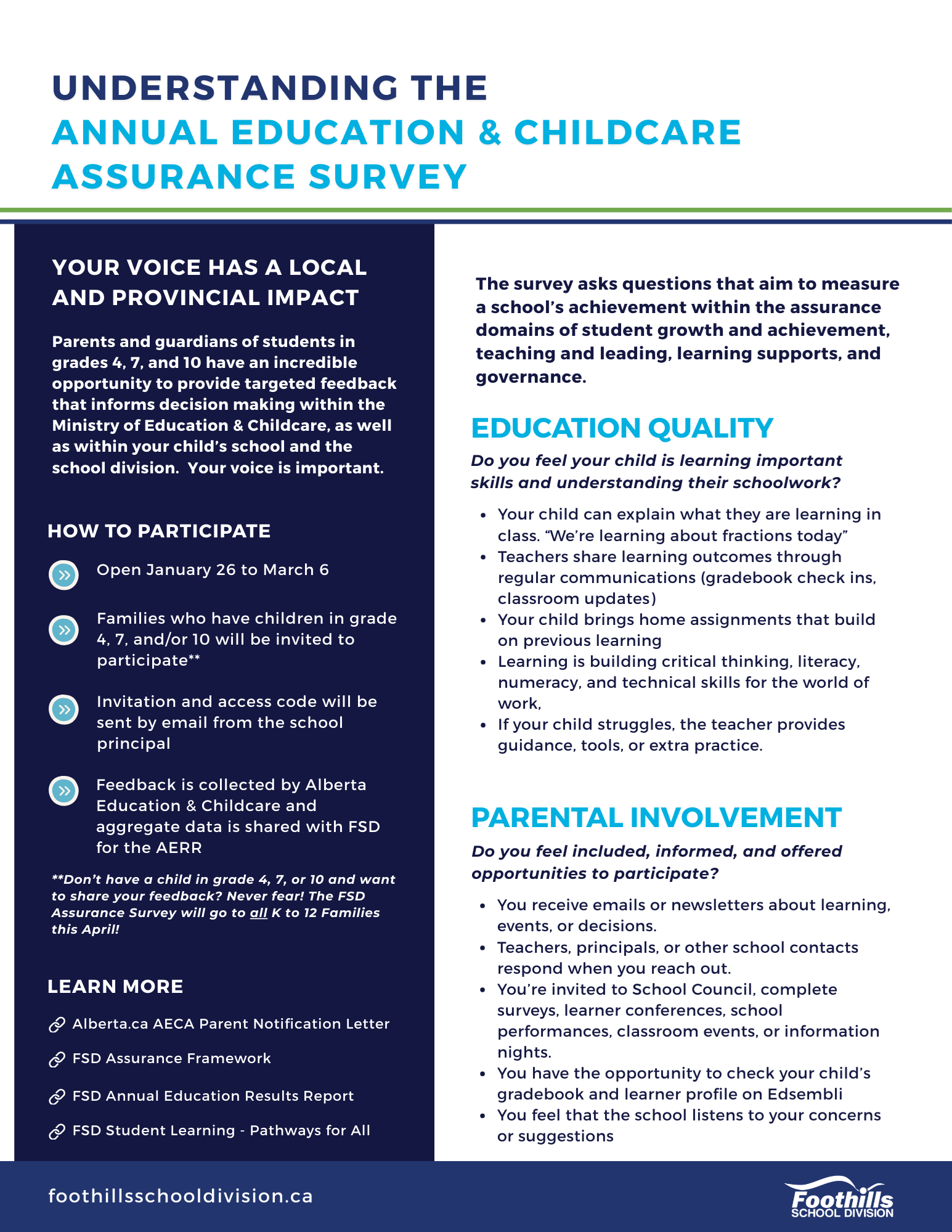 Click to view printable version
How to Participate
- Open January 26 to March 6
- Families who have children in grade 4, 7, and/or 10 will be invited to participate**
- Invitation and access code will be sent by email from the school principal
- Feedback is collected by Alberta Education & Childcare and aggregate data is shared with FSD for the AERR
**Don’t have a child in grade 4, 7, or 10 and want to share your feedback? Never fear! The FSD Assurance Survey will go to all K to 12 Families this April!
What is the AECA?
The Alberta Education & Childcare Assurance (AECA) survey asks questions that aim to measure a school’s achievement within the assurance domains of student growth and achievement, teaching and leading, learning supports, and governance.
Education Quality
Do you feel your child is learning important skills and understanding their schoolwork?
- Your child can explain what they are learning in class. “We’re learning about fractions today”
- Teachers share learning outcomes through regular communications (gradebook check ins, classroom updates)
- Your child brings home assignments that build on previous learning
- Learning is building critical thinking, literacy, numeracy, and technical skills for the world of work,
- If your child struggles, the teacher provides guidance, tools, or extra practice.
Parental Involvement
Do you feel included, informed, and offered opportunities to participate?
- You receive emails or newsletters about learning, events, or decisions.
- Teachers, principals, or other school contacts respond when you reach out.
- You’re invited to School Council, complete surveys, learner conferences, school performances, classroom events, or information nights.
- You have the opportunity to check your child’s gradebook and learner profile on Edsembli
- You feel that the school listens to your concerns or suggestions
Safe, Caring & Welcoming Schools
Does the school create an environment where your child feels safe, respected, and treated fairly?
- Your child feels comfortable going to school each day.
- School staff greet students and use supportive and positive language.
- Your child has a positive peer group in class and/or through clubs and teams.
- Conflicts are handled respectfully and fairly.
- Your child has trusted adults at school they can talk to.
Student Learning Engagement
Is your child curious, motivated, and invested in what they’re learning?
- Your child talks about their learning at home “Guess what we did in science!”
- They show persistence when work is challenging.
- They enjoy hands‑on projects, group work, or creative problem‑solving.
- They are excited about classroom topics or activities.
Program of Studies
Is your child getting access to a variety of subjects beyond the basics?
- Your child takes part in arts, music/band, makerspace, CTF, CTS, drama, and/or another language in school (French Immersion, French as Second Language, Spanish).
- They explore different topics and interests throughout the year.
- They talk about real‑world connections in their learning.
Life Long Learning
Does your child learn how to learn — not just what to learn?
- Your child has set personal learning goals or reflects on their progress.
- They develop confidence in trying new things.
- They learn to ask questions, research, and think critically.
- Your child is learning transferrable skills.
School Improvement
Based on your experience, is the school making positive changes?
- You notice new programs, activities, stronger communication.
- You feel your child is more supported or more engaged this year.
- You’ve seen the school’s plans to improve in the Education Plan and Annual Education Results Report.
Access to Supports and Services
When your child needs help, support is available.
- School teams help your child with friendship challenges or worries.
- You’re aware of the formal supports available in the school or division including:
- Family School Liaison Counsellors
- Youth Development Coach
- Minds Matter
- Academic and Career Advisors
- Learning Coach
- Your child has access to books, learning tools, or additional resources in the classroom or learning commons.
- Your child’s learning needs are met with relevant materials and resources.
Work Preparation
Is the school helping your child develop habits and skills they’ll use beyond school?
- Your child is practicing responsibility (meeting deadlines, organizing their work).
- They use collaboration, communication, and problem‑solving in class.
- Your child is learning to be independent, respectful, and resilient.
- (Grade 7 & 10) students explore careers, pathways, or leadership roles.
Citizenship
Is your child learning to be kind, respectful, cooperative, and globally aware?
- Students help each other in class and within the school setting.
- Your child learns about empathy, fairness, and making responsible choices.
- They participate in acts of service, leadership, or community‑building activities, such as Students’ Matters or other groups in school.
- They show respect for others’ cultures and perspectives.
Learn More

